


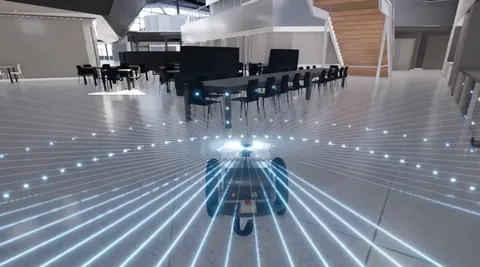
Indoor robotics has seen rapid advancements in recent years, but navigating dynamic, cluttered spaces with precision still remains a major challenge. Traditional methods like floor-based SLAM (Simultaneous Localization and Mapping) often struggle with inconsistencies caused by moving objects, variable lighting, or blocked sensors. Enter Ceiling Vision SLAM—an innovative navigation approach that leverages the ceiling’s stability for more reliable localization and mapping. It’s transforming autonomous systems across industries. One standout provider in this space is MRDVS, offering intelligent ceiling vision SLAM solutions designed for high-accuracy navigation in even the most demanding environments.
This article will explore how ceiling vision SLAM works, the technology behind it, its many benefits, and how it’s being applied in real-world scenarios. We’ll also compare it to traditional methods and offer practical advice for businesses considering this technology.
What Is Ceiling Vision SLAM?
Ceiling Vision SLAM refers to a type of visual SLAM that uses upward-facing cameras to track unique patterns, objects, and features on the ceiling to help robots understand their position and environment. It essentially flips the traditional approach by avoiding ground-level obstructions and using the ceiling—typically an uncluttered and consistent surface—as the primary point of reference.
In a standard SLAM system, robots try to build maps and localize themselves by scanning the walls or floor. However, this can be affected by people walking around, shelves moving, or reflective surfaces. Ceiling vision SLAM bypasses those issues and offers a more robust and scalable alternative.
How Ceiling Vision SLAM Works
At the heart of ceiling vision SLAM is a visual mapping system that identifies and tracks ceiling landmarks—such as pipes, lights, tiles, or ducts—to determine the robot’s exact position. Here’s a step-by-step breakdown of how the system typically works:
- Capture Ceiling Images
A camera mounted on the robot captures continuous images of the ceiling. - Feature Detection
Advanced algorithms extract distinguishable ceiling patterns from these images. - Real-Time Localization
As the robot moves, it compares current visual data to previously stored images to accurately determine its location. - Map Creation
The robot builds a visual map of the space based on the detected ceiling features. - Autonomous Navigation
Using the generated map, the robot plans and adjusts its path dynamically in real time.
This process allows the robot to move smoothly through indoor environments without being disrupted by floor-level activity.
Key Advantages of Ceiling Vision SLAM
Ceiling Vision SLAM offers significant benefits over traditional methods of robot localization. Below are some of the core advantages:
- Higher Accuracy
Because ceiling features are typically stable and less prone to change, they provide more consistent reference points. This leads to more accurate localization and fewer mapping errors. - Less Environmental Interference
Foot traffic, boxes, machinery, or floor debris can obscure floor-level sensors. Ceiling vision avoids these issues entirely. - Lower Cost
Compared to LiDAR-based systems, camera-based SLAM systems are generally more affordable and require less maintenance. - Easier Scalability
Once a ceiling map is created, it can be reused and shared across a fleet of robots, enabling seamless multi-robot coordination. - Improved Performance in Dynamic Environments
Facilities that undergo frequent layout changes—like e-commerce warehouses or production floors—benefit greatly from the adaptability of ceiling vision.
Use Cases and Industry Applications
The utility of ceiling vision SLAM spans a wide range of indoor environments. Below are some key applications:
Warehousing and Logistics
In warehouses, AMRs (Autonomous Mobile Robots) equipped with ceiling vision SLAM can navigate aisles, pick up items, and deliver goods accurately—even when the layout changes due to shifting inventory.
Manufacturing Facilities
Manufacturing floors often include heavy machinery and moving human operators. Ceiling vision ensures that robots don’t get confused or misdirected by these unpredictable variables.
Healthcare and Hospitals
In hospitals, service robots need to navigate hallways, patient rooms, and labs without human oversight. Ceiling vision SLAM ensures reliable navigation even during busy hours.
Airports and Public Spaces
Robots used for cleaning, information assistance, or delivery in airports and shopping malls benefit from ceiling SLAM’s ability to function in environments with high human traffic.
Ceiling Vision SLAM vs. Traditional Navigation Methods
Here’s a comparison table that highlights how ceiling vision SLAM stacks up against more traditional methods:
| Feature | Ceiling Vision SLAM | Floor-Based SLAM | LiDAR-Based SLAM |
| Accuracy | High | Moderate to High | High |
| Obstruction Interference | Low | High | Medium |
| Cost | Low to Moderate | Low | High |
| Maintenance | Low | Low | Moderate to High |
| Ease of Deployment | Easy | Moderate | Complex |
| Scalability | High | Medium | Medium |
The table makes it clear that ceiling vision SLAM offers a strong combination of reliability and affordability, especially in large and active facilities.
Key Technologies Behind Ceiling Vision SLAM
To function effectively, ceiling vision SLAM relies on an ecosystem of hardware and software components. These include:
- High-Resolution Cameras
Used to capture ceiling images in real-time. - Visual Odometry
Tracks movement by comparing sequential images and estimating the robot’s motion. - Feature Matching Algorithms
Identify unique patterns on the ceiling and match them across frames to localize the robot. - IMU (Inertial Measurement Units)
Provide orientation and acceleration data to supplement the vision system. - AI and Machine Learning
Continuously improve feature recognition, noise reduction, and map accuracy. - Edge Computing
Ensures that all visual data is processed in real time without relying on external cloud services.
Implementation Considerations
Before adopting ceiling vision SLAM, here are a few things you should evaluate:
- Ceiling Structure
Ensure your ceiling includes identifiable features. If not, artificial markers can be added. - Lighting Conditions
Uniform lighting improves feature detection. Avoid glare or overexposed regions. - Robot Design
Your robot must be able to accommodate an upward-facing camera with a clear field of view. - Software Integration
Choose a SLAM system that integrates easily with your robot control software or warehouse management system. - Scalability
Opt for systems that allow shared maps and coordination across multiple robots.
What’s Next for Ceiling Vision SLAM?
The future of ceiling vision SLAM is bright, with innovations in AI, vision sensors, and cloud robotics pushing the boundaries of what’s possible. Here’s what we can expect:
- Self-Learning Systems that continuously update and refine maps on the go.
- Hybrid Vision-LiDAR SLAM systems for environments requiring extreme precision.
- Fleet-Level Optimization, allowing multiple robots to share data and avoid traffic jams.
- AR Integration, overlaying SLAM-generated maps with real-time visual information for human operators.
Conclusion
As industries continue to adopt automation for increased productivity and safety, Ceiling Vision SLAM offers a powerful and practical solution to indoor robot navigation. By leveraging the static and consistent nature of ceiling environments, this approach delivers higher accuracy, lower maintenance, and more robust performance in dynamic spaces.
Whether you’re managing a warehouse, hospital, or factory, this technology provides the kind of dependable navigation robots need to operate independently. If you’re ready to upgrade your robotic systems with advanced visual navigation, ceiling vision SLAM is a forward-looking investment that delivers real value.
